- Queer Word
- Posts
- 🦵 is it gay to cross your legs? 🦵
🦵 is it gay to cross your legs? 🦵
oh look! another innocuous habit we’ve been trained to overthink!

K Anderson
February 06, 2026
QUEER WORD
KNEE-OVER-KNEE
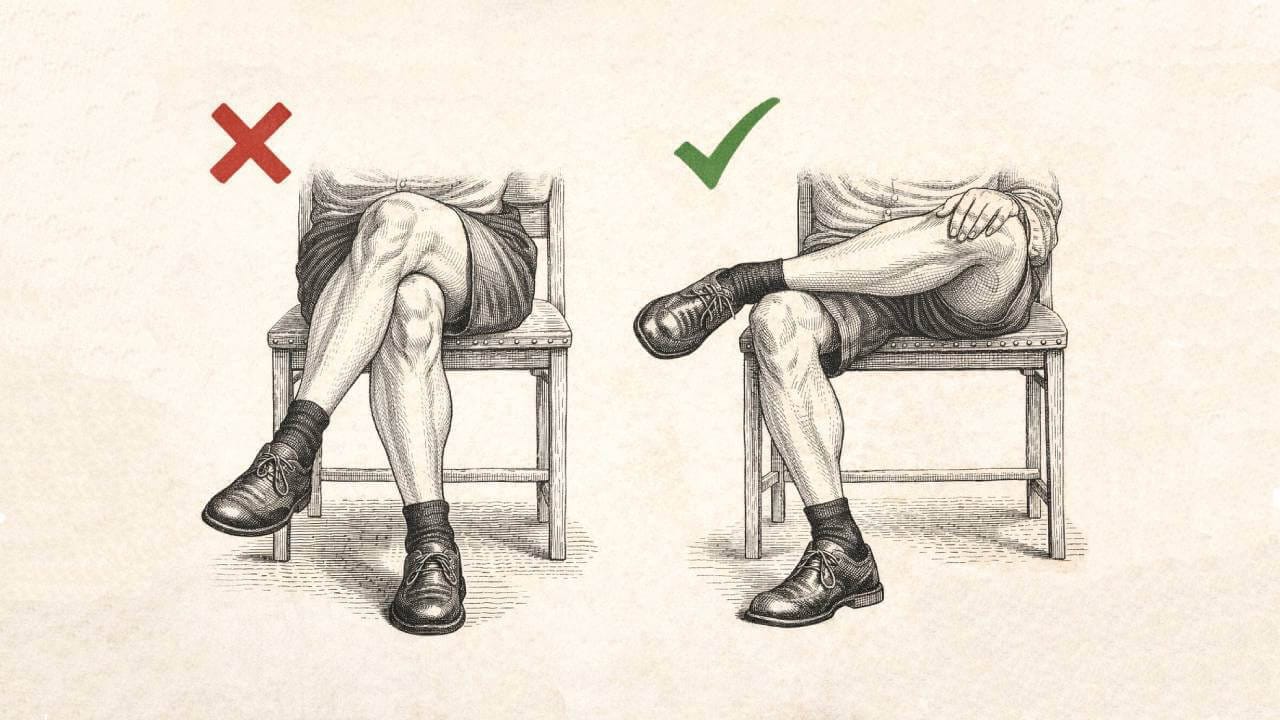
What It Means:
A seated position where one knee is placed directly on top of the other, with the legs crossed tightly at the knees.
Though it's just a way of sitting, it's often culturally read as restrained or feminine, and has been used to police how male bodies are allowed to exist in public spaces.
Let’s Use It In A Sentence:
Zachary noticed, halfway through the meeting, that he was sitting knee-over-knee, and immediately tried to untangle his legs before anyone else spotted it.
A little bit of history:
Western boys learn from a very young age that there's a 'right' way and a 'wrong' way to cross your legs.
Ankle-over-knee? Fine, apparently.
Knee-over-knee? No, no, no. Too much.
Too feminine. Too fey. Too neat.
But would you believe me if I said it hasn't always been this way?
(Well, yeah, you probably would. After all, most of the social rules we live by are completely made-up nonsense that we've somehow collectively bought into, enforced on children, punished deviations from, and then forgotten were invented in the first place…. But that's a rant for another day.)
For now, let's look at the interesting history of leg crossing etiquette.
When The ‘Rules’ First Appeared
No one seemed to be hugely bothered about how people sat (or, if they were, they didn’t write it down) until the Victorian and Edwardian era, when etiquette manuals started giving step-by-step instructions on how to behave in polite society.
In the 1800s, when these manuals first appeared, the rules were fairly straightforward:
For women: Crossing legs at the knee was absolutely improper. 'Ladylike' posture means knees together, ankles crossed.
For men: knee-over-knee was acceptable, but knees far apart or ankle-over-knee were not.
As fashions changed in the early 1900s, women's clothing became less restrictive, the taboo around crossing at the knee also started to loosen.
So much so that by the time Emily Post’s Etiquette was published in 1922, women were being actively encouraged to cross their knees (though with the usual moralising caveats about remaining demure and not ‘exaggerating’ your stance [whatever that means]).

Emily Post’s Etiquette helped codify what counted as ‘good behaviour’ in the 20th century
By the mid-20th century, crossing at the knee had become completely normalised for women.
Which meant, of course, that it started to be read as ‘feminine.’
When The ‘Rules’ Changed
Once crossing your legs at the knee became coded as feminine, it didn’t take long for men to start avoiding it.
Because in a culture like ours (oh, you know, the kind that’s deeply misogynsitic/homophobic/generally problematic), being read as ‘feminine’ is rarely neutral. It’s just a quick hop, skip, and a jump from ‘a bit girly’ to ‘sissy’ or ‘queer.’ And boys learn that very early.
So, over the course of just a few decades, the norms quietly flipped. The ankle-over-knee position, which was once considered sloppy or uncouth, became the acceptable way for men to cross their legs. Knee-over-knee, meanwhile, started to attract attention.
And attention is the thing boys are trained to avoid.
Any boy who naturally sat knee-over-knee quickly learned to correct himself. To uncross. To shift. To take up more space. Not necessarily because anyone explicitly told him to, but because 'difference' is policed in all sorts of unspoken ways, and queer kids become very adept at noticing and navigating those invisible booby traps.
And though we're (maybe?) more relaxed now about how people choose to sit in public, it's fascinating how sticky these rules remain. I still catch myself doing the little shuffle. Still feel that flicker of self-consciousness. Still subconsciously clock it when I see a man sit knee-over-knee in a cafe or on the tube.
For something I know is nothing but a social construct, it’s annoyingly hard to shake.
POLL: Have you ever consciously changed how you sit because of how it might be read? |