- Queer Word
- Posts
- 👪️ what's the opposite of 'chosen family'? 👪️
👪️ what's the opposite of 'chosen family'? 👪️
a more precise way of talking about the family that helped mess you up

K Anderson
April 24, 2026
QUEER WORD
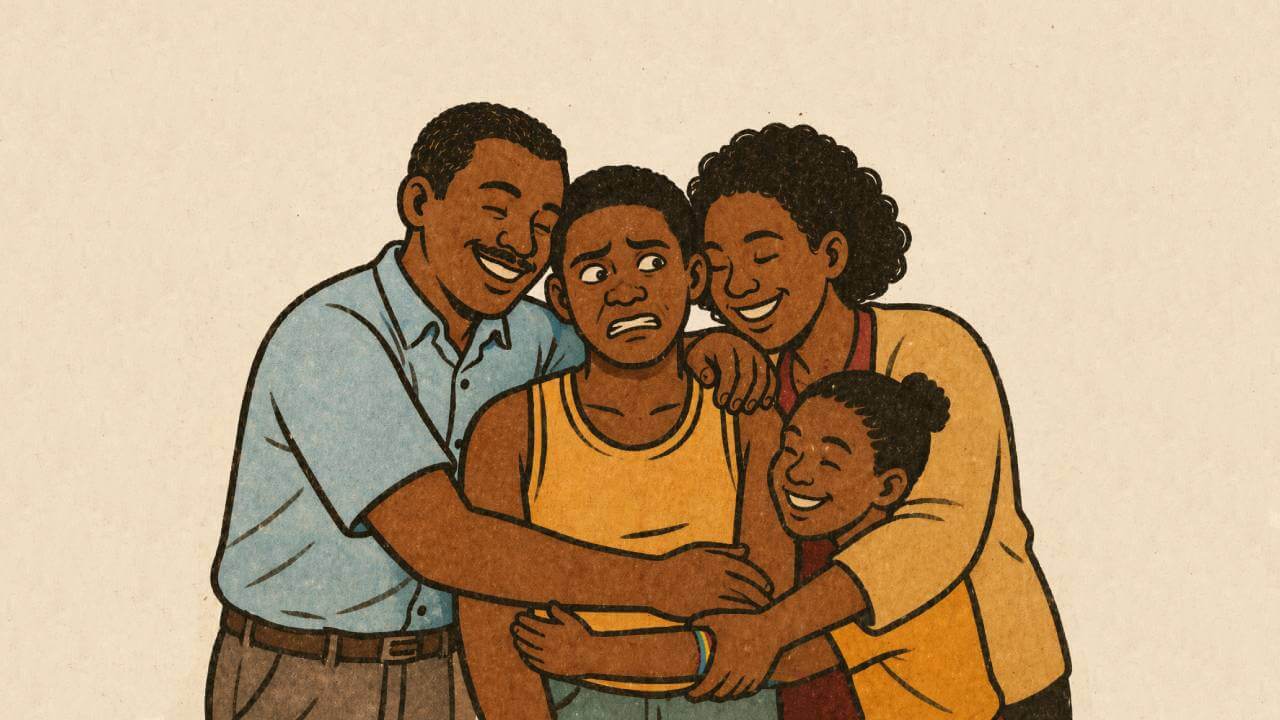
FAMILY OF ORIGIN
What It Means:
a term commonly used in therapy and family systems work to describe the family or caregivers you grew up with, whether biological, adoptive, foster, or otherwise.
Let’s Use It In A Sentence:
Priya's chosen family and her family of origin had absolutely nothing in common. Except, annoyingly, for their uncanny ability to push exactly the same buttons.
What’s The Opposite of ‘Chosen Family’?
I have a bit of a complicated relationship with the concept of chosen family.
Not because I don’t think it’s vital, or life-saving, or humongously important for a lot of queer people.
But because I think it’s become a bit over-romanticised and idealised. It’s often talked about as though it’s this idyllic, harmonious little institution that’ll solve all of your problems, when in reality it can be just as messy, dysfunctional, and weird as any other family.
And, more than that, I sometimes think the way we talk about chosen family ends up dismissing or minimising the role of the family you actually grew up with.

the tv show Schitt’s Creek is the perfect example of a family of origin, the dynamic being messy, loyal, emotionally repressed, and somehow, despite all of this, capable of growth
Yeah, for some people, the family they grew up with was awful, and they did need to escape their little hometown in order to find themselves amongst a ragtag band of misfit queers.
But that’s not always the case.
Sometimes the family you grew up with still matters enormously, even if the relationship is difficult, fractured, or complicated. Sometimes you still talk every day, even if it always somehow ends in a squabble. Sometimes they did a decent job in some ways and a terrible one in others. Sometimes they’re no longer central to your life, but still loom very large in it.
Which is why I’m pleased to see the term family of origin getting a bit more traction, including in queer scholarship, where there’s been a growing recognition that the family you came from doesn’t just disappear once chosen family enters the picture.
Because for all the cultural attention queer people have rightly given to chosen family, the family of origin never really disappears. They’re still there in the background of so much of who we become. Our habits, our fears, our expectations, our emotional damage, our voices, our coping mechanisms, our passive-aggressive way of saying ‘it’s fine’ whenever we’re faced with conflict (just me?).

Armistead Maupin’s Tales of the City shows that, in very bizarre cases, our chosen family can also be our family of origin (those who know, know)
But why this term over others? Well, to me, it’s:
more precise than ‘your real family’
less loaded than terms like ‘biological family’
broad enough to include adoptive parents, foster carers, grandparents, and anyone else who actually raised you
oddly comforting in its sterility, because it names the relationship without imbuing it with any additional meaning or sentiment
So, in all honesty, it’s likely I’m going to continue to feel a bit dubious about chosen family for a while yet.
But I am glad that family of origin is gaining more prominence in our vocabulary, and I hope we can get to a place where both are equally valued and acknowledged (or at least blamed equally for screwing us up irreversibly).
POLL: Do you think queer culture over-romanticises 'chosen family'? |